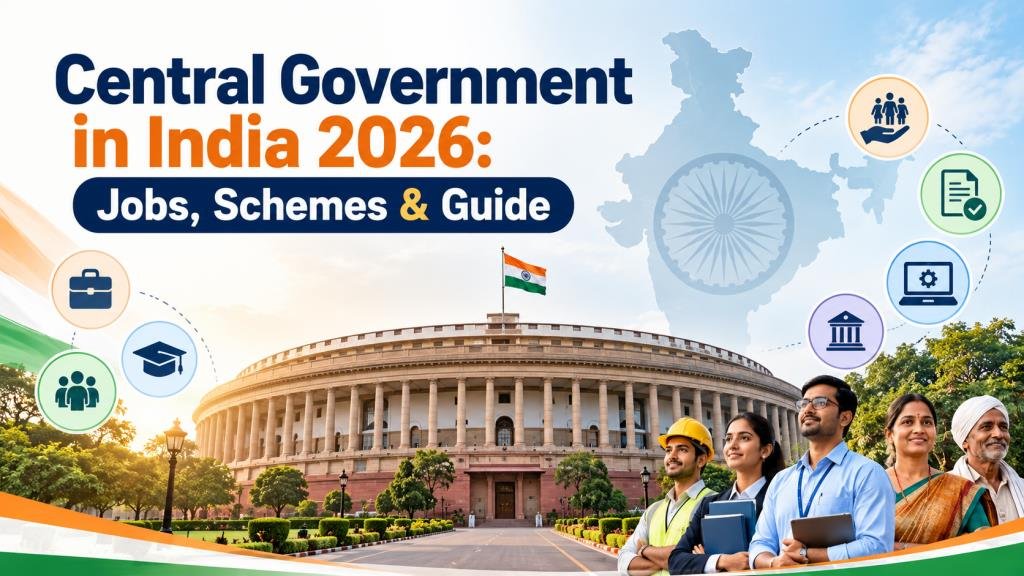
Central Government in India 2026: Jobs, Schemes & Guide
Introduction
The Central Government of India plays an important role in managing the country and improving the lives of its people. It makes national laws, manages important public services, protects the country, and introduces development programmes. Its decisions affect millions of people across India.
Many citizens want to understand how the Central Government works. Students look for information about its structure and responsibilities. Job seekers search for government vacancies, while families want to learn about welfare schemes and financial benefits.
Understanding these topics can help people make better decisions. This guide explains the important functions, departments, jobs, salaries, and schemes of the Indian government in simple English.
What Is the Central Government in India?
The Central Government, also known as the Union Government, is the national government of India. It manages matters that affect the entire country. These include national defence, foreign relations, currency, railways, and other important services.
India follows a federal system with powers shared between the Union and the states. The Constitution explains which level of government can make laws on different subjects. The Central Government works from New Delhi, the capital of India. It includes important institutions such as the President, Parliament, Prime Minister, and Union ministries.
On JobzHunting.in, readers can explore useful information about Central Government jobs, recruitment opportunities, and public services to better understand career options in India.
The Union Government also works with state governments to carry out national policies. This cooperation is important because many development programmes require support at both national and local levels.
History and Evolution of the Central Government in India
The history of India’s Central Government is closely connected with the country’s independence and Constitution. Before independence, India was governed under British rule. The British administration introduced several laws and institutions that influenced the country’s later government structure.
India became independent on August 15, 1947. However, the country continued working toward a new constitutional system. On January 26, 1950, the Constitution of India came into effect. India became a republic with a democratic parliamentary system.
The Constitution established the powers of the Union Government, state governments, and important institutions. It also guaranteed fundamental rights to citizens. Over time, the government introduced changes to improve administration, public services, and economic development.
Economic reforms in 1991 changed India’s business environment. Later, digital technology helped government departments introduce online applications, electronic records, and faster public services.
Today, the Central Government uses both traditional administration and modern digital systems to manage its responsibilities.
Structure of the Central Government: Executive, Legislature and Judiciary
The Indian government has three main branches: the Executive, Legislature, and Judiciary. Each performs a different function within the constitutional system. The Executive is responsible for implementing laws and managing government administration. It includes the President, Prime Minister, Council of Ministers, and public officials.
The President is the constitutional head of the country. The Prime Minister leads the Council of Ministers and directs the work of the government. The Legislature makes laws and discusses important national matters. India’s Parliament consists of the President, Lok Sabha, and Rajya Sabha.
Lok Sabha is the House of the People. Its members are directly elected by eligible voters. Rajya Sabha is the Council of States and represents the states and certain Union Territories. The Judiciary interprets laws and protects constitutional rights. The Supreme Court is the highest court in India.
An important distinction is that the judiciary is independent. It is not a department controlled by the Central Government. Together, these institutions help maintain constitutional government, accountability, and the rule of law.
How Does the Central Government Work in India?
The Central Government works through a parliamentary democratic system. People elect representatives to the Lok Sabha during general elections. A political party or coalition that can command the confidence of the Lok Sabha normally forms the government. The President appoints the Prime Minister.
The Prime Minister leads the Council of Ministers. Different ministers manage different ministries, such as Finance, Education, Defence, and Health. Government policies are developed through discussions, administrative planning, and Cabinet decisions.
When a new law is required, a bill may be introduced in Parliament. It must pass through the required legislative process and receive presidential assent to become law. After that, government departments and other authorities work to implement it.
Parliament also reviews government actions. Members can ask questions, debate policies, and examine public spending. Accountability is an essential part of the Indian parliamentary system. Ministers must answer for government decisions, and the Council of Ministers is collectively responsible to the Lok Sabha.
Powers and Functions of the Central Government
The Central Government has several important responsibilities under the Constitution. One major responsibility is national defence. The Union Government manages the armed forces and makes decisions related to national security.
Foreign affairs are another important function. The government maintains diplomatic relations with other countries and represents India in international organisations. The Central Government also manages important financial matters. These include currency, national taxation policies, government borrowing, and the Union Budget.
It regulates several major areas of national importance, including railways, telecommunications, and international trade. The government also develops infrastructure policies. National highways, major transport projects, and public investment programmes support economic activity.
Education, healthcare, employment, and social welfare are other important areas. Many of these responsibilities are shared with state governments. The main purpose of the Central Government is to manage national affairs and promote public welfare within the Constitution.
Central Government Ministries and Departments in India
The Central Government carries out its work through ministries and departments. Each ministry manages particular subjects and public programmes. For example, the Ministry of Finance handles major financial and budget matters. It plays an important role in taxation, government spending, and economic administration.
The Ministry of Home Affairs deals with internal security and several matters related to national administration. The Ministry of Defence manages defence policies and matters involving the armed forces.
The Ministry of Education works on education policies and programmes. The Ministry of Health and Family Welfare handles important national health initiatives. Other major ministries include Railways, External Affairs, Agriculture and Farmers Welfare, Labour and Employment, and Road Transport and Highways.
Each ministry may contain multiple departments, offices, and attached organisations. According to the National Portal of India’s ministry directory, 53 Union ministries were listed when checked in October 2026. Government structures may change, so readers should consult the official directory for updates.
Official ministry information is available through india.gov.in.
Central Government vs State Government: Key Differences
India has both Central and State Governments. They work at different levels and perform different responsibilities. The Central Government manages national matters, while state governments mainly manage responsibilities within their respective states.
The Constitution divides legislative subjects into the Union List, State List, and Concurrent List. Parliament generally makes laws on Union List subjects. State legislatures generally make laws on State List subjects. Both can legislate on Concurrent List subjects, subject to constitutional rules.
For example, defence and foreign affairs are Union subjects. Police and public order are generally state subjects. Education appears in the Concurrent List, meaning both levels of government can legislate in this area.
Central Government vs State Government Comparison Table
| Feature | Central Government | State Government |
|---|---|---|
| Area of authority | Entire country | Respective state |
| Constitutional executive head | President | Governor |
| Political executive head | Prime Minister | Chief Minister |
| Legislature | Parliament | State Legislature |
| Main subjects | Defence, foreign affairs, currency | Police, public order, public health |
| Law-making authority | Parliament | State Legislature |
| Main administrative location | New Delhi | State capital |
| Government employees | Union departments and services | State departments and services |
| Elections | Lok Sabha elections | State Assembly elections |
| Public programmes | National-level schemes | State-level schemes |
Both levels of government are important for India’s development. Many public services depend on cooperation between Union and state authorities.
Who Runs the Central Government in India in 2026?
As of October 17, 2026, Narendra Modi is the Prime Minister of India. He began his third consecutive term on June 9, 2024. The Prime Minister is the head of government. He leads the Council of Ministers and plays a central role in national policymaking.
Droupadi Murmu is the President of India. She became the 15th President on July 25, 2022. The President serves as the constitutional head of state. Presidential powers are exercised according to the Constitution, generally on the aid and advice of the Council of Ministers.
Union ministers are responsible for their assigned ministries. They oversee policies, administrative work, and national programmes. The Central Government also depends on civil servants and public institutions to carry out daily administrative activities.
Citizens can find official information about the current Prime Minister at pmindia.gov.in and the President at presidentofindia.gov.in.
Learn More: Fast Job Search: Best Methods to Find Jobs in India
Central Government Jobs 2026: Recruitment, Eligibility and Opportunities
Central Government jobs are popular in India because many positions offer structured pay, career development, and employment benefits. Recruitment takes place through different organisations. The exact process depends on the department and job category.
Some of the major recruitment bodies include:
- Union Public Service Commission (UPSC): Conducts examinations for Civil Services and various other Union-level posts.
- Staff Selection Commission (SSC): Recruits candidates for many Group B and Group C positions.
- Railway Recruitment Boards (RRBs): Conduct recruitment for various railway positions.
Other government bodies and departments also conduct their own recruitment processes. Job opportunities may be available in administration, engineering, accounts, education, healthcare, defence, and technical services.
The educational requirements vary. Some posts accept candidates with Class 10 or Class 12 qualifications. Others require a diploma, graduation degree, or professional qualification. Age limits and reservation rules also depend on the recruitment notification.
Candidates should always read the official advertisement before applying. It provides details about qualifications, application fees, age limits, examination patterns, and selection procedures.
For recruitment information, candidates can visit upsc.gov.in, ssc.gov.in, and the relevant Railway Recruitment Board websites. A vacancy should not be considered open simply because an older recruitment article remains online. Always verify its closing date and current status.
Central Government Employees: Salary, Allowances and Benefits
Central Government employees receive salaries according to the rules that apply to their posts and services. Many civilian employees are covered by the 7th Central Pay Commission pay matrix. Their basic salary depends on the pay level and applicable service rules.
In addition to basic pay, eligible employees may receive Dearness Allowance, House Rent Allowance, and Transport Allowance. Dearness Allowance (DA) helps employees manage changes in the cost of living. Its rate is revised through government decisions.
House Rent Allowance (HRA) is linked to factors such as the employee’s posting location and applicable rules. Employees may also receive medical facilities, leave benefits, travel concessions, and retirement-related benefits, depending on eligibility.
The government has also constituted the 8th Central Pay Commission. Its official website provides updates about its work and notifications.
However, the creation of a Pay Commission does not automatically mean that a new salary structure has already been implemented. Employees should follow official orders rather than unconfirmed salary predictions.
Retirement benefits also differ by service category and joining date. The Unified Pension Scheme (UPS) took effect on April 1, 2025, as an option under the National Pension System for eligible Central Government employees. Its benefits depend on prescribed conditions.
Employees should check the latest pension rules and applicable deadlines before making retirement-related decisions.
Central Government Schemes 2026: Major Welfare Programs and Benefits
The Central Government introduces welfare schemes to support different sections of society. These schemes may provide financial assistance, healthcare access, housing support, education benefits, or help for farmers and small businesses.
Some important national programmes include:
- PM-KISAN: Provides financial support to eligible farmer families under the scheme’s rules.
- Ayushman Bharat PM-JAY: Offers hospitalisation coverage to eligible beneficiaries under the programme.
- Pradhan Mantri Awas Yojana (PMAY): Supports housing needs through its applicable urban and rural components.
- Pradhan Mantri Jan Dhan Yojana (PMJDY): Promotes financial inclusion through access to banking services.
- National Social Assistance Programme (NSAP): Supports eligible vulnerable groups through social assistance programmes.
Scheme eligibility is not the same for everyone. It may depend on income, age, occupation, family details, location, or other conditions. In October 2026, the Union Cabinet approved continuation of the National Social Assistance Programme for the financial years 2026–27 through 2030–31, along with certain revisions.
This shows why citizens should check current official guidelines instead of depending on older articles. The myScheme portal, available at myscheme.gov.in, helps users discover government schemes and understand their eligibility requirements.
Applicants should use the relevant official scheme website to confirm application procedures, required documents, and benefit details.
Central Government Policies and Major Development Initiatives
The Central Government develops policies to support economic growth, public infrastructure, technology, and social development. Digital India is an important initiative focused on digital services, connectivity, and technology use.
Digital services can reduce paperwork and make some government processes easier. Citizens can access various documents and services without visiting multiple offices.
Make in India focuses on encouraging manufacturing, investment, and business development. The government also supports entrepreneurship, innovation, and skill development through different programmes.
Infrastructure is another major priority. Roads, railways, airports, energy projects, and communication networks are important for long-term economic development. Education and healthcare policies aim to improve opportunities and public services. Their success depends on implementation, funding, and cooperation among institutions.
However, announcing a policy is different from achieving its goals. A useful way to review government initiatives is to examine their actual results, including service quality, accessibility, cost, and benefits for ordinary citizens. Public reports, budget documents, and independent assessments can help readers understand these outcomes.
Central Government Online Services and Official Websites
The Central Government provides many online services for citizens, students, employees, and businesses. The National Portal of India, available at india.gov.in, is an important starting point. It provides access to information about ministries, departments, services, and government organisations.
DigiLocker allows users to access supported digital documents and certificates. It is useful for students, job applicants, and citizens who need verified records. UMANG brings together many government services through a common digital platform.
The myScheme portal helps citizens find government welfare schemes that may match their eligibility. For public grievances, the CPGRAMS portal at pgportal.gov.in provides a system for submitting and tracking complaints concerning public service delivery.
People can also use official recruitment websites to apply for government examinations and jobs. When using online services, citizens should make sure they are visiting genuine websites. Fake recruitment notices and misleading scheme links can lead to financial loss or misuse of personal information.
Never share OTPs, passwords, or sensitive banking details with unknown agents claiming to represent the government. Official information should always be checked before making payments or submitting personal documents.
Achievements, Challenges and Future of the Central Government
The Central Government has contributed to India’s development in several areas, including infrastructure, digital services, financial inclusion, and public welfare. Digital platforms have made many services easier to access. Online applications, electronic payments, and digital records have reduced the need for physical paperwork in many situations.
Public investment in transport and communication has also supported economic activity. Welfare programmes have created additional channels of support for eligible families, farmers, and other groups.
However, important challenges remain. Unemployment and competition for jobs are major concerns for many young people. Government recruitment receives significant attention because available positions often attract large numbers of applicants.
Differences between urban and rural areas can also affect access to education, healthcare, internet services, and employment opportunities. Administrative delays remain another concern. Some citizens face difficulties with applications, documentation, grievance resolution, and benefit delivery.
There are also challenges related to environmental protection, public spending, population needs, and economic inequality. The future of the Central Government will depend partly on how effectively it addresses these issues.
Technology, better public administration, transparent decision-making, and cooperation with state governments may help improve services. A balanced review should recognise progress without ignoring problems. Government performance should be assessed using reliable evidence rather than political claims alone.
The most important measure of effective governance is how public decisions improve people’s lives.
Frequently Asked Questions (FAQs) About the Central Government in India
What is the Central Government of India?
The Central Government is India’s national government. It manages national responsibilities such as defence, foreign affairs, currency, and important public services.
Who is the head of the Central Government in India?
The President is the constitutional head of state. The Prime Minister is the head of government and leads the Council of Ministers.
Who is the Prime Minister of India in 2026?
As of October 17, 2026, Narendra Modi is the Prime Minister of India. He began his third consecutive term in June 2024.
What is the difference between Central Government and State Government?
The Central Government handles matters of national importance. State governments manage many responsibilities within their states. The Constitution divides legislative powers between them.
Which jobs are available under the Central Government?
Opportunities include administrative, railway, technical, defence, clerical, engineering, and other public service positions. Vacancies depend on the recruiting department.
How can I apply for Central Government jobs?
Visit the official website of the recruiting body. Read the notification, check eligibility, complete the application, and follow the examination or selection process.
What is the minimum qualification for Central Government jobs?
It depends on the post. Some vacancies require Class 10 or Class 12 qualifications. Others require graduation, a diploma, or specialised education.
What benefits do Central Government employees receive?
Eligible employees may receive basic pay, allowances, leave benefits, medical facilities, and retirement benefits under the rules that apply to their services.
What are the major Central Government schemes?
Important examples include PM-KISAN, Ayushman Bharat PM-JAY, PMAY, PMJDY, and social assistance programmes. Eligibility and benefits vary.
Where can I find official Central Government information?
Visit india.gov.in for general information. For recruitment, schemes, and employee matters, use the official websites of the relevant departments.
Conclusion
The Central Government of India plays a central role in the country’s administration, security, economy, and development. From managing national policies to providing public services, its decisions affect people across the country.
Understanding the government’s structure and functions can help citizens recognise their rights and responsibilities. For students and job seekers, information about Central Government jobs, recruitment, qualifications, salaries, and benefits is especially valuable.
Welfare schemes and digital services can also support eligible people, but official rules must always be checked before applying. India’s government system continues to develop as technology and public needs change. Strong institutions, effective administration, and public accountability will remain essential.
By using reliable government websites and keeping up with official updates, citizens can make better decisions about employment, benefits, and public services.